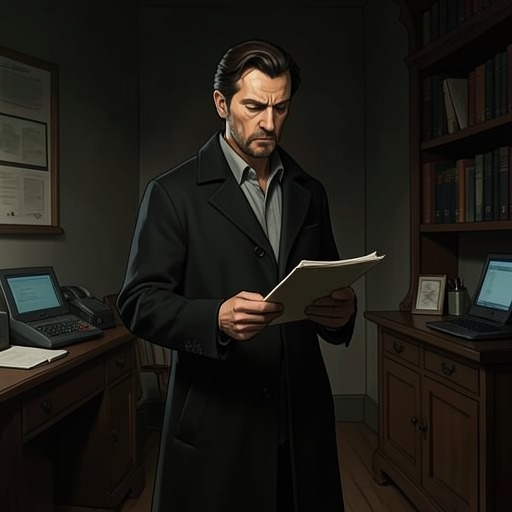
Maple Falls PD
The Birthday PartyMaple Falls PD is the local police agency at the center of the investigation into Charlie Hamilton’s disappearance and the attack on Megan Carter. Through Detective Chase Cooper and the officers and specialists working alongside him, the department turns an initially uncertain report into a coordinated search: it alerts the public, interviews witnesses, examines the birthday-party site and a home, and tries to protect evidence before it can be lost. Its role also reaches beyond fieldwork, as its visible presence and carefully limited public statements shape how the families experience the investigation.
Role and Personnel
The evidence presents Maple Falls PD through the work of particular people rather than a comprehensive account of its organization. Chase Cooper is the detective directing the response, while Detective Frank Brown assists at the party site. A uniformed female officer is assigned to watch the Hamilton family’s home, and additional personnel include a K9 unit and forensic specialists. The novel does not set out the department’s full hierarchy or procedures; it shows these people working in parallel as the search expands.
The first information Chase has is the report made to dispatch: the Hamiltons cannot locate their five-year-old daughter, and they believe she is with her babysitter, Megan Carter. Mitch Hamilton supplies the crucial timeline. Kathy Hamilton left Charlie at a birthday party on Lexington Lane before two o’clock, and Megan was expected to collect her at four. Mitch has searched around town without finding either of them, and Megan is not answering her phone or door. This account gives the investigation its immediate locations and questions, but not an explanation for the disappearance.
Search and Coordination
At the birthday-party house, Chase and Brown speak with guests while their memories are still fresh. The accounts offer no decisive lead: several people last saw Charlie on, or waiting for, a pony near the woods. With no confirmed whereabouts, Chase arranges for an AMBER Alert to be issued. The alert is intended to circulate Charlie’s identifying information through media outlets quickly and enlist public help while there may still be time to find her.
The department also divides work between locations. After receiving information that takes him to Megan’s apartment, Chase leaves another officer to go there and sends Letts to replace him at the party site, where Brown is still working. Chase’s journey between the apartment and the birthday-party house links two strands of the crisis: the missing child and the adult who had been expected to collect her. When he finds Megan in need of urgent help, he ensures an ambulance is on its way and then returns to the search for Charlie. The sequence shows the department responding to an unfolding situation rather than treating the disappearance as an isolated report.
Searches and Evidence Preservation
The first search of the party site extends into the night. Officers examine the yard, while the K9 unit searches the woods beyond it. Darkness creates a practical limit: handlers are concerned their dogs could become trapped or fall into water, so Chase accepts that a thorough search of the woods must wait until first light. The postponement is not a conclusion that the area is unimportant; it reflects the danger of pressing the search under poor conditions.
Inside the house, the timing is equally consequential. At 10:30 p.m., the search has not yet begun, and Chase considers the effect on the hosts’ young twins. He also recognizes that waiting until morning could allow evidence to be disturbed or destroyed, intentionally or otherwise. Once the search proceeds, he tells Brown to have forensic specialists examine glasses, plates, and door handles for fingerprints. The party has left behind numerous objects that may carry DNA or prints, and their value depends in part on the family not having cleaned them away. Chase’s stated investigative purpose includes checking whether a person later denies having attended can be placed at the party.
This work gives ordinary household disorder an investigative significance. The guests’ glasses and food dishes are not merely remnants of a celebration: before they are cleared, they may preserve traces that help establish who was present. In the same way, the party guests’ fresh recollections, the K9 search, and the physical examination of the home are different forms of evidence-gathering, each with its own constraints. Maple Falls PD’s response in these scenes is methodical but incomplete; at this point, neither interviews nor the initial outdoor search has established where Charlie went.
Public Presence and Disclosure
The department’s involvement becomes visible beyond the search sites. A uniformed officer remains outside the Hamilton home, and the officer checks in periodically with updates from Chase. Kathy experiences the patrol car as both reassurance and a reminder that the family itself may be under scrutiny. Chase has described the officer’s presence as protection, but Kathy worries that he may suspect her or Mitch of involvement. The same assignment therefore carries two meanings in the family’s experience: a safety measure and an unmistakable sign that the investigation has reached their doorstep.
At a press conference, Chase stands in front of the cameras with Kathy and Mitch behind him and identifies them publicly as Charlie’s parents. When a reporter asks where they were when Charlie disappeared, he confirms that both were at work. He does not mention that Megan was expected to collect Charlie. Megan understands this omission as a deliberate effort not to redirect attention from the search toward her attack and personal history. Chase has told her he will disclose a possible connection between the incidents if he finds evidence for one, but until then he is limiting what is made public. The scene presents public communication as part of the investigation: what the department confirms, and what it withholds for the time being, can affect where scrutiny falls.
Investigative Pressure and Significance
The department’s questioning also prompts the family to reveal information that changes the terms of the case. After the press conference, Chase asks whether Kathy or Mitch has anything else to disclose, warning that pressure on them will increase. Kathy then tells him that Charlie is adopted and has lived with the Hamiltons for six months. The disclosure emerges under investigative pressure, not from a public announcement, and alters what the family has told police about Charlie’s identity and history.
Maple Falls PD is thus portrayed through a combination of urgency, evidence management, public visibility, and unanswered questions. Its officers can issue an alert, coordinate interviews and searches, preserve potential forensic material, and make decisions about what to communicate; those actions do not immediately produce certainty. The account repeatedly distinguishes activity from resolution: witnesses have been interviewed, the dogs’ search has limits, and the party house is being examined, while Charlie’s whereabouts remain unknown. That gap is central to the agency’s narrative role. The department organizes the community’s response to the disappearance, but its work unfolds amid incomplete evidence, family secrets, and the possibility that the public story may change as new facts emerge.